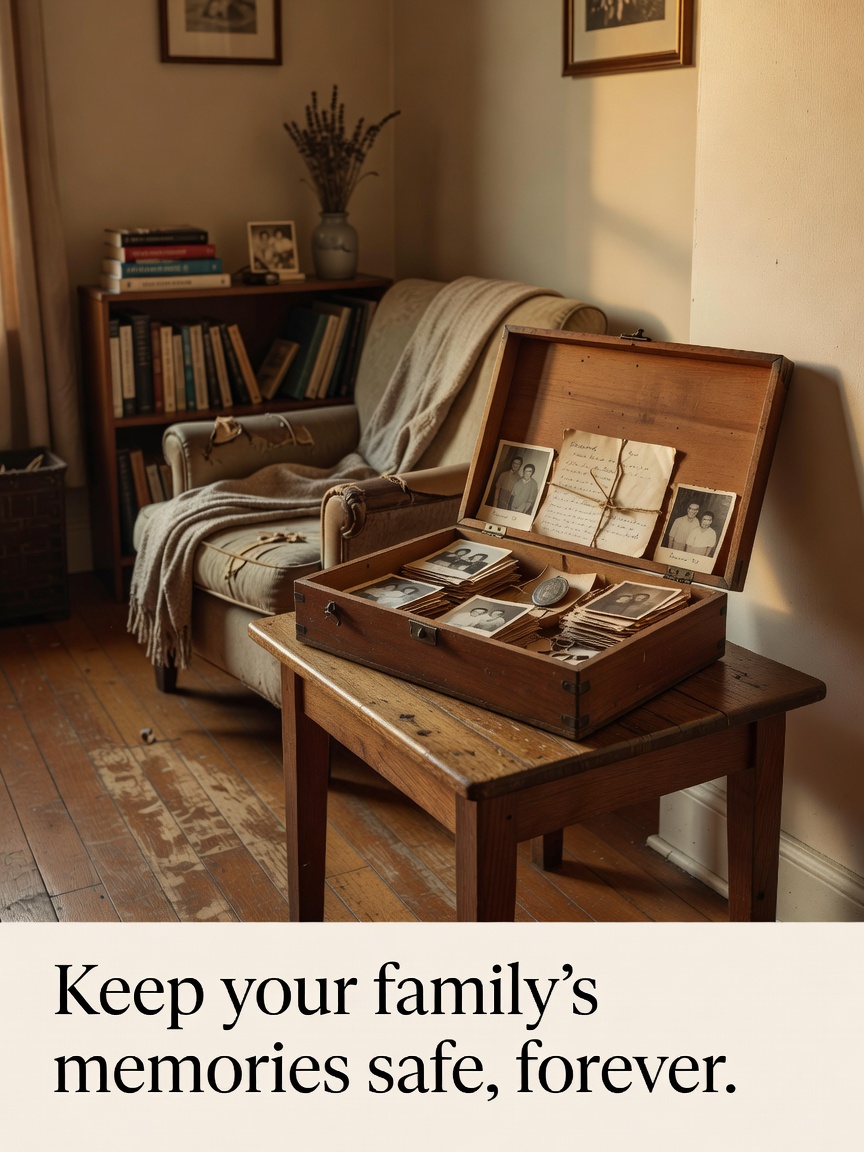
My grandpa had this box of old photographs, tucked away in his closet. Not fancy albums, just a shoebox full of loose prints, black and white mostly, some faded to sepia. It made me realize the need for the best app for preserving family memories. Every time I visited, I’d pull it out. He’d sit beside me, his finger tracing the faces, and tell me who everyone was. Not just names, you know? He’d tell me about the time Aunt Millie tried to ride a goat at the county fair, or how Uncle George built his first radio receiver from scratch when he was twelve.
Kinnect is now LIVE! Start your private family group today.
👉 Try Kinnect on the Web
👉 Download the iOS App
Those stories. They were the real treasure, not just the pictures themselves. The photos were just the door, the key, to something much deeper. They showed me faces, places, moments frozen in time. But it was his voice, the way he laughed when he remembered something particularly silly, the hint of sadness when he spoke of someone long gone, that brought those flat images to life.
And then he was gone. And the box of photos is still here, but the stories? Most of them are gone too. I remember some fragments, pieces of conversations, but the rich tapestry he wove with every picture, every memory shared aloud, that’s largely faded. It’s a quiet ache, this realization that I held so many of those stories in my hands, literally, but didn’t do enough to hold onto his telling of them.
We live in a world overflowing with photos. Our phones are bursting with them. Social media feeds scroll endlessly with new images, day in and day out. We snap everything: breakfast, sunsets, vacations, selfies with friends. But how many of those photos come with a caption that truly explains the moment, the emotion, the backstory? How many come with the voice of the person who experienced it?
Not many. We assume we’ll remember. We assume the story will just stick with the image. But it doesn't. Not really. Time blurs things. New memories push old ones aside. And the people who lived those moments, who hold the keys to those narratives, they won't be around forever.
And that’s the real problem, isn't it? We’re excellent at capturing the visual. We're terrible at capturing the narrative. We’re losing the irreplaceable context that makes a photo more than just pixels on a screen. A picture is just a picture. A picture with a story, told in the voice of the person who lived it, that’s a piece of legacy. That’s something you can truly preserve.
How to capture the real stories, not just the snapshots
So, what do we do about it? We can try to write things down, of course. Keep a journal, or interview family members with a recorder. And some families do that, with great dedication. But it’s a lot of work. Setting up interviews, transcribing, organizing, storing. It often feels like another chore on an already overflowing to-do list, and it’s easy to put off until it’s too late.
Or we could just share more on social media. But those platforms aren’t built for permanence. They’re built for fleeting attention, for the moment. Stories get buried under new posts, lost in algorithms, and sometimes disappear entirely when a platform changes or shuts down. And not everyone wants their family’s intimate stories broadcast to a wider, less private audience.
What we need is something different. Something that makes it easy to capture those stories as they happen, or as they're remembered, without feeling like a massive project. A way to weave the narrative directly into the fabric of our family's shared history, where it’s safe and accessible, but also deeply private.
We need a tool that understands the difference between a fleeting post and an enduring legacy. A place where the memories aren't just seen, but heard, felt, and truly understood. And where that understanding can be passed down without effort, without fear of loss.
This is precisely the kind of problem Kinnect was designed to solve. It’s a private, invite-only platform that helps families preserve memories, stories, and essential life information across generations. It’s not social media; it’s infrastructure for your family’s continuity. With Kinnect's Echo feature, daily questions and prompts build into a permanent private archive. It’s not a feed or a chat; it’s a growing record of your family's real stories over time. Each answer, often given in voice, is dated, searchable, and stays in your group forever. It’s about saving what matters before it’s too late, ensuring those voices, those specific details, and the answers to questions that will matter after someone is gone, are truly preserved.
Q: Why are stories more important than just photos?
A: Photos show us what happened, but stories tell us why it mattered. They provide context, emotion, and personal perspective, transforming a static image into a living memory. Stories are the soul of a family's history, giving depth and meaning to the visual record.
Q: How can I encourage older family members to share their stories?
A: Start small and make it a natural part of conversation. Instead of a formal interview, ask about a specific photo or a particular memory that comes to mind. Show genuine interest and be a good listener; often, a gentle prompt is all that's needed.
Q: What's the best way to organize family memories?
A: The best way is whatever you'll actually use. Digital platforms that allow for tagging, searching, and chronological organization are often most effective. The key is to have a consistent system that makes it easy to add new memories and retrieve old ones.
Q: How do I make sure these stories aren't lost?
A: The most crucial step is active capture and secure storage. Don't rely solely on individual memory. Use tools designed for preservation, ensure multiple family members have access, and back up digital files regularly to prevent accidental loss.
Q: What kind of memories should I focus on preserving?
A: Focus on the everyday, the funny anecdotes, the challenges overcome, and the lessons learned, alongside major life events. These smaller, more personal stories often reveal the most about a person and a family's unique identity. The seemingly ordinary often becomes extraordinary with time.
Keep reading
Kinnect is now LIVE!
Experience the private family network on the web or download the iOS app today.
Staying organized is a big part of keeping family close, especially when coordinating with siblings for aging parents. Learn more about how you can reconnect your family with a shared calendar for aging parents.
Deep Dive: More Resources on This Topic
If you found this helpful, explore our related guides:
