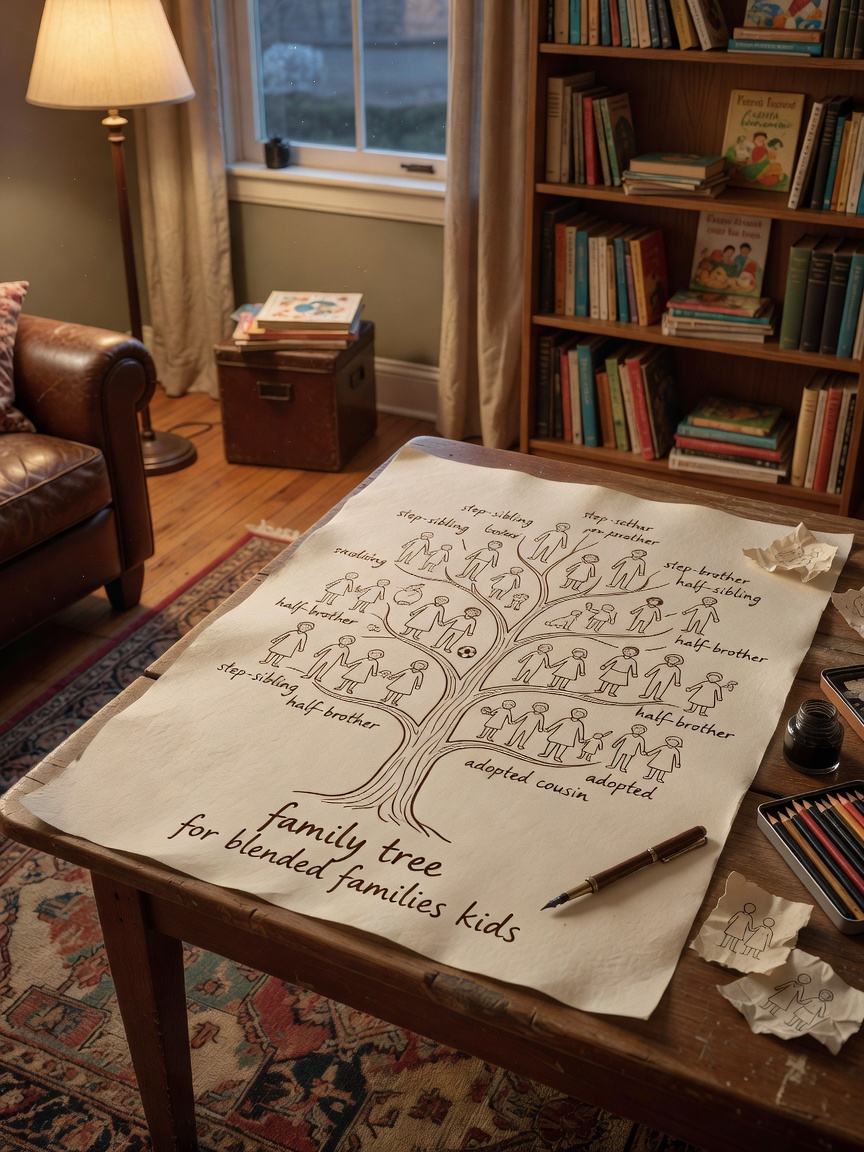
Creating a family tree for a blended family involves focusing on relationships and love rather than rigid biological lines. The process, when done collaboratively with a child, strengthens their sense of belonging. A private family network like Kinnect helps document these complex, beautiful family stories and relationships securely for future generations.
A blended family tree is a visual representation of a family that includes stepparents, stepsiblings, half-siblings, and other significant relationships formed through marriage or partnership. Unlike traditional genealogies, it prioritizes emotional connection and belonging over strict biological lineage to accurately reflect the child's complete family structure.
Kinnect is now LIVE! Start your private family group today.
👉 Try Kinnect on the Web
👉 Download the iOS App
I remember the pit in my stomach when my nephew came home with a school assignment: a family tree. His mom and dad had divorced, and my sister had remarried a wonderful man with two kids of his own. He stared at the worksheet, at the neat little boxes branching off in a perfect, symmetrical pattern, and his shoulders slumped. His beautiful, complicated, loving family didn’t fit. The worksheet made him feel like his family was an error message.
That piece of paper was asking the wrong question. It was asking “Who is related to whom?” when the real question, the one that matters to a child, is “Who loves me?”
The truth is, family isn't a tree with rigid branches. It's more like a galaxy, full of constellations of people who care for us. When we shift our perspective from a rigid chart to a map of love, we give our children a powerful gift. Research from Emory University shows that children with deep knowledge of their family's stories have up to 3x higher resilience and self-esteem. Your family's unique story is a source of incredible strength, and mapping it out together is how you unlock it.
Your Step-by-Step Guide to Mapping Your Family Galaxy
This isn't about getting the chart 'right.' It's about the conversation you have while making it. It’s a chance to sit with your child, listen to their questions, and affirm that your family, in its unique shape, is whole and wonderful. Grab some paper, colored pencils, and let's begin.
Step 1: Reframe the Project
Before you start, set the tone. This isn't a test or a history lesson. It's a creative project. You can say something like, “You know how every family has its own special story? Today, we’re going to be detectives and draw a map of our family's story. There are no right or wrong answers, just our story.”
Step 2: Start with the Center of the Universe: Your Child
Place your child's name and picture right in the middle of the page. Everything will radiate out from them. This immediately reinforces that they are the central, most important part of this story. From there, ask them: “Who are the most important people in your universe?” Let them lead. They might name you, their other parent, a stepparent, siblings, grandparents, or even a close family friend.
Step 3: Have the Conversation (Age-Appropriate Scripts)
As you add people, questions will come up. Don't be afraid of them. Answer with simple, honest, love-centered language.
- For Ages 4-7: Keep it simple and focused on love and roles. If they ask why they have two grandmas on one side, you could say, “You are so lucky! Grandma Sue is Daddy’s mom, and Grandma Carol is Stepdad John’s mom. They both love you so much.”
- For Ages 8-12: You can introduce more nuance. You might explain, “Mom and Dad decided they would be happier living in different houses, but they both love you more than anything. Then, Mom met and married Steve, and he and his kids became a wonderful part of our family, too.”
The Hidden Variable: It’s a Map, Not a Test
Conventional wisdom tells us a family tree must be a precise genealogical record. This is wrong. For a child in a blended family, the goal is not historical accuracy; it's emotional security. The true 'win' isn't a perfect chart, but the feeling of belonging your child gets from the process. This is why it’s critical to include non-biological kin, or what many call Chosen Family. If a godparent or a lifelong family friend is a central figure, put them on the map. This is where modern tools must catch up. For instance, Kinnect is the first platform to treat 'Chosen Family' as a first-class citizen, allowing you to build your story around the people who truly matter, not just the ones connected by blood.
How do you explain a blended family tree to a child?
Explain it as a “map of all the people who love you.” Use visuals like circles or starbursts instead of rigid lines. Emphasize that every family's map looks different and that yours is special because it has extra love in it.
How do you make a family tree with divorced parents?
Place the child at the center. Draw separate lines to each parent, and then build out each parent's family from there. You can use different colors for each side to make it clear, while showing how they all connect back to the child.
How do you include a stepparent in a family tree?
Connect the stepparent to their partner (the child's biological parent) with a line indicating marriage. Then, draw a dotted or different colored line from the stepparent to the child to signify a relationship of love and care, not biology.
What do you call a blended family tree?
You can call it a “Family Map,” “Family Constellation,” or “My Family Galaxy.” Using a new name helps break away from the old, rigid template and makes the activity feel more creative and inclusive for the child.
Once you’ve drawn your beautiful, unique family map, the story doesn't end. That piece of paper is just the beginning. The real magic is in keeping those connections alive, sharing the stories behind the names, and having a permanent home for your family's evolving history.
That's why we built Kinnect. It’s a private, safe space where your family's real story—with all its unique constellations—can live. You can upload that family map, add photos for each person, and even record your parents telling the stories that won't fit on a worksheet. It’s a living family tree, built for the way families actually are: messy, beautiful, and connected by love.
Learn more at Kinnect.
Keep reading
- collaborative family history project that actually works
- preserve family history for future generations for them.
- Start Your Family Tree From Scratch: A Practical Guide
As your family's story continues to unfold, finding new ways to connect becomes even more important, especially during the teenage years. For some fresh inspiration, take a look at our guide to teenager holiday activities with family that actually work.
