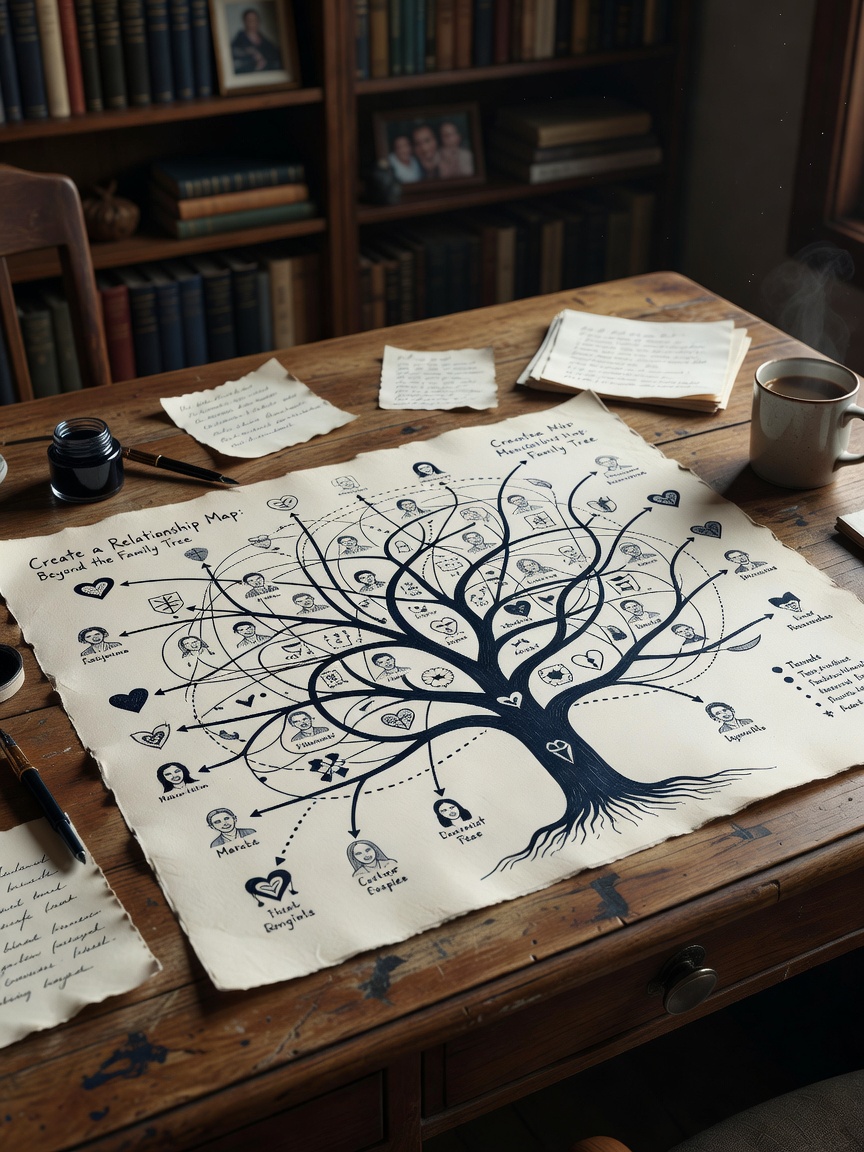
I remember the day my son came home from school with a family tree assignment. He had a small box for my husband and me, and then lines going up to our parents. But there was no box for my best friend, who was more of a sister to me than my own, or for the neighbor who practically raised me after my mom passed away. On that piece of paper, the people who shaped my heart were invisible. A traditional family tree is a map of genetics, but it’s often a terrible map of love.
For generations, we've been taught that family is a rigid structure of biological and legal ties. But for most of us, that model feels incomplete. It erases the step-parent who showed up to every game, the mentor who guided your career, and the friends who became your chosen family. These connections aren’t just footnotes to your life; they are the story of your life. When our primary tool for documenting family leaves no space for our most important bonds, it sends a painful message that those relationships are somehow less real or valid.
Why a standard family tree falls short
A typical family tree is excellent for tracing lineage and ancestry. However, it's a one-dimensional tool that fails to capture the complex, beautiful reality of our lives. It has no way to visually represent the bonds that truly define us.
- Chosen Family: It omits the people we deliberately select to share our lives with, who offer mutual support, understanding, and unconditional love, which is especially vital for those who feel misunderstood by their family of origin.
- Mentors and Influential Figures: There is no branch for the teacher, coach, or boss who saw your potential and altered the course of your life.
- Blended and Adoptive Families: While you can use dotted lines for adoption, standard trees often fail to show the emotional depth and reality of step-parent or adoptive relationships in a meaningful way.
- Complex Emotional Dynamics: A family tree shows you are related, but it doesn't show how. It can't distinguish between a close, supportive bond and one that is distant, strained, or estranged.
- Non-Human Family: For many, pets are significant members of the family, offering companionship and unconditional love. A traditional tree has no place for them.
This is why we need a new kind of map—a relationship map—that tells the whole truth. It's a way to finally draw a picture of your family that looks and feels like your actual experience, honoring the legacy of impact, not just genetics.
Ready for a private family space?
Kinnect is invite-only family infrastructure — stories, updates, and connection without ads.
👉 Join on the web
👉 Get the iOS app
How to create your own relationship map
Creating a relationship map isn't a clinical exercise; it's an act of honor. It requires honesty and a willingness to see your family as a constellation of love rather than a rigid chart. You don’t need special software—a pen and paper work just fine.
A simple guide to mapping your connections
- Start with yourself at the center. Unlike a top-down family tree, a relationship map begins with your own experience. Place your name in the middle of the page.
- Add the key people in your life. Think beyond traditional roles. Add your parents (biological, step, or adoptive), siblings, partners, and children. Then, add your closest friends, key mentors, influential colleagues, and even beloved pets. Don't worry about structure yet; just get the names down.
- Create a legend for your connections. This is where the map comes to life. Instead of just straight lines, create a key to represent the feeling of each relationship. For example:
- A thick, solid line could mean a strong, supportive bond.
- A wavy line could represent a conflicted or challenging relationship.
- A dotted line could signify a distant or infrequent connection.
- You could add a heart for mentorship or a lightning bolt for a tense bond.
- Draw your connections and add stories. Using your legend, draw the lines from you to each person. On those lines, or next to their names, jot down a short memory or a word that defines the connection. This context is what transforms a simple diagram into a meaningful story.
What's the difference between a relationship map and a genogram?
A genogram is a more formal tool often used in therapy and social work. It uses a standardized set of symbols to map family history, including emotional dynamics, medical conditions, and behavioral patterns. A relationship map, on the other hand, is a more personal and flexible tool you create for yourself to honor all the significant connections in your life, using your own symbols and definitions.
Can I include difficult or estranged relationships?
Absolutely. The goal of a relationship map is to create an honest picture of your life. Including strained or severed connections can be a powerful way to acknowledge their impact. You can use a specific line style, like a jagged or broken line, to represent these complex dynamics.
How do I represent blended or adoptive family members?
A relationship map is perfect for blended and adoptive families. You can use specific line styles (like a dashed or colored line) to signify a step- or adoptive relationship, placing these individuals in a way that reflects their emotional closeness to you, not just their formal connection on a chart.
What is the best tool for creating a relationship map?
While pen and paper are a great start, digital tools can help you build a map that can be easily updated and shared. A private family platform like Kinnect is designed for this very purpose, allowing you to not only draw these connections but also to save the stories, photos, and memories that give each relationship its meaning, treating every member of your chosen family as a first-class citizen.
Ready for a private family space?
Kinnect is invite-only family infrastructure — stories, updates, and connection without ads.
👉 Join on the web
👉 Get the iOS app
Map chosen + blended family for real — then keep it private
Kinnect’s living Family Tree is for blood, step, half-siblings, and chosen family — not DNA kits or public Ancestry graphs. Add people, stories, and who actually shows up.
Invite the people who belong. · Family Membership $20/year · six seats.
👉 Join — open your Kin Group
👉 Family Membership $20/yr · six seats
👉 Get the iOS app