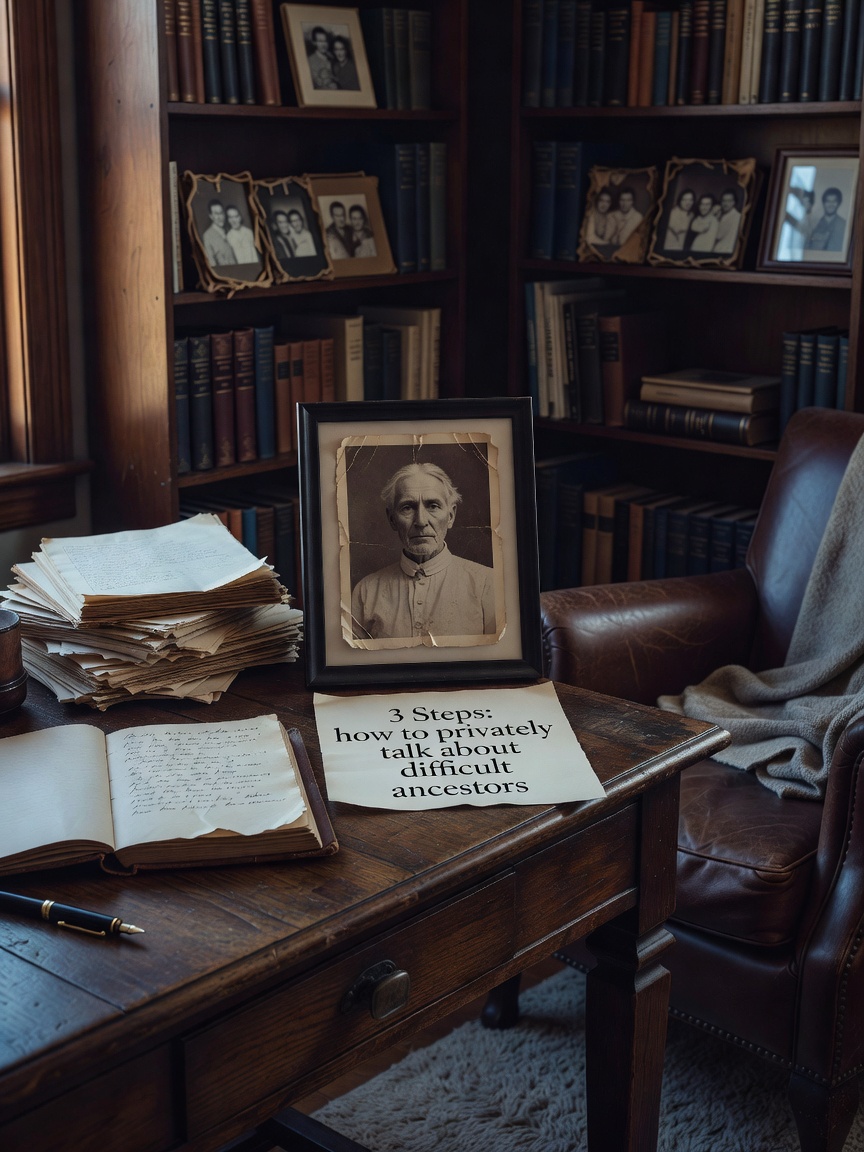
Discussing controversial ancestors is the process of communicating sensitive or challenging historical information about a family member with living relatives. This practice requires careful preparation, emotional intelligence, and a focus on factual accuracy to navigate potential conflict and preserve family relationships.
You trace a line back, and suddenly, there it is. A name attached to an act you can’t ignore. A census record that lists a different family. A court document that tells a story of violence or crime. It’s a heavy silence to hold alone. I remember when I found out my great-grandfather, a man my mom adored, had abandoned his first wife and children. The man she knew as a hero had a past she never knew. The anxiety wasn't just about the fact itself, but about the conversation I knew I had to have with her. How do you share a truth that might shatter someone's most cherished memories?
This isn't about shaming the dead. It's about understanding the whole, complicated, human story of who we are. Before you ever speak a word to a relative, you have to prepare the ground, both factually and emotionally.
Kinnect is now LIVE! Start your private family group today.
👉 Try Kinnect on the Web
👉 Download the iOS App
Before the Conversation: Preparing the Ground
The success of this conversation happens long before you sit down to talk. Your preparation is an act of love and respect for your family and your shared history.
Define Your Goal: Why are you having this conversation? Is it to gather more information, to share a burden you're carrying, to correct the family record, or simply to understand? Knowing your 'why' will keep you grounded if the conversation becomes difficult. Be clear with yourself first.
Gather Your Sources: This isn't about opinions or hearsay; it's about what you found. Have the primary sources—the census record, the newspaper clipping, the military file—available. When you can point to a document, it shifts the conversation from an accusation to a shared discovery: "Look what I found. What do we make of this together?"
Prepare Emotionally: Acknowledge your own feelings. Are you angry, sad, ashamed, confused? Your emotions are valid. Taking a moment for emotional regulation before the talk will help you stay calm and listen, rather than just react to whatever your family member brings to the table.
The Step-by-Step Script for a Difficult Conversation
When you're ready to talk, the structure of the conversation matters. You are not dropping a bomb; you are inviting someone into a complex discovery. This requires a gentle, step-by-step approach.
Step 1: The Invitation
Never ambush someone with difficult information, especially not at a holiday gathering. Ask for permission to have the conversation at a specific time. This gives them agency and prepares them mentally.
Script: "Hi Mom, I've been doing some deep dives into our family history, and I came across some complex information about Great-Grandpa John. It's been on my mind, and I'd love to find a quiet time to share what I found and hear your perspective. Would you be open to that next week?"
Step 2: Setting the Scene
Choose a private, neutral, and comfortable setting where you won't be interrupted. This should be a one-on-one conversation. Bringing this up in a group setting can make people feel ganged up on and trigger defensive reactions.
Step 3: The Opening Statement
Start with "I" statements and lead with the document, not the judgment. You are a fellow explorer, not a prosecutor.
Script: "Thanks for talking with me. As I was looking through the 1920 census records, I found something that surprised me. It looks like Great-Grandpa John was listed with another wife and children before he met Grandma. I'm trying to make sense of it, and I hoped you might have some insight."
The Hidden Variable: The Loyalty Bind
Conventional wisdom assumes that when a relative gets defensive about a controversial ancestor, they are defending the ancestor's actions. But that's rarely the case. They are often caught in a loyalty bind—a subconscious feeling that criticizing an ancestor is a betrayal of the person they loved who is connected to them (e.g., their own mother or father). The defensiveness isn't about the facts; it's about protecting their own cherished relationship with the person who told them the simpler, cleaner story. Understanding this helps you respond with empathy, not argument.
Step 4: Navigating the Reaction
After you share, stop talking. Your most important job now is to listen. They may react with denial, anger, sadness, or even relief. Validate their feelings, whatever they are.
Active Listening Scripts:
If they're defensive: "I can see this is upsetting to hear. My intention isn't to attack his memory, but to understand the full story."
If they're sad: "It sounds like this is really painful to think about. I'm so sorry."
If they deny it: "I understand why it's hard to believe. Would you be willing to look at the document with me?"
Knowing these complex stories is a part of building a strong family identity. In fact, research from Emory University shows that children who score in the top third on family story knowledge show up to 3x higher resilience and self-esteem scores than those with little knowledge of their family history. These conversations are hard, but they make the family stronger.
These discussions are rarely a one-time event. They are the start of weaving a more honest, complete family story. But where do you keep that story safe? Public social media platforms, with their data mining and performative nature, are the wrong place for this sacred work. Kinnect was built to be that private, permanent home—a shared space where you can document the difficult truths alongside the joyful memories, ensuring the full, human story is passed down, not just the polished version.
Frequently Asked Questions
How do you deal with problematic ancestors?
Acknowledge their actions without making excuses. Focus on understanding them in their historical context while separating their deeds from your own identity. The goal is comprehension and documentation, not endorsement or erasure.
How do you talk to relatives about family history?
Approach the conversation with curiosity, not accusation. Schedule a private time, share the documents or sources you've found, and use 'I' statements to express how the information made you feel. Be prepared to listen more than you speak.
How do you write about a difficult family member?
Write with nuance and context. Present the facts clearly, citing your sources, but also explore the motivations and historical pressures they may have faced. Acknowledge the impact of their actions on others to create a balanced, truthful narrative.
Learn more at Kinnect.
