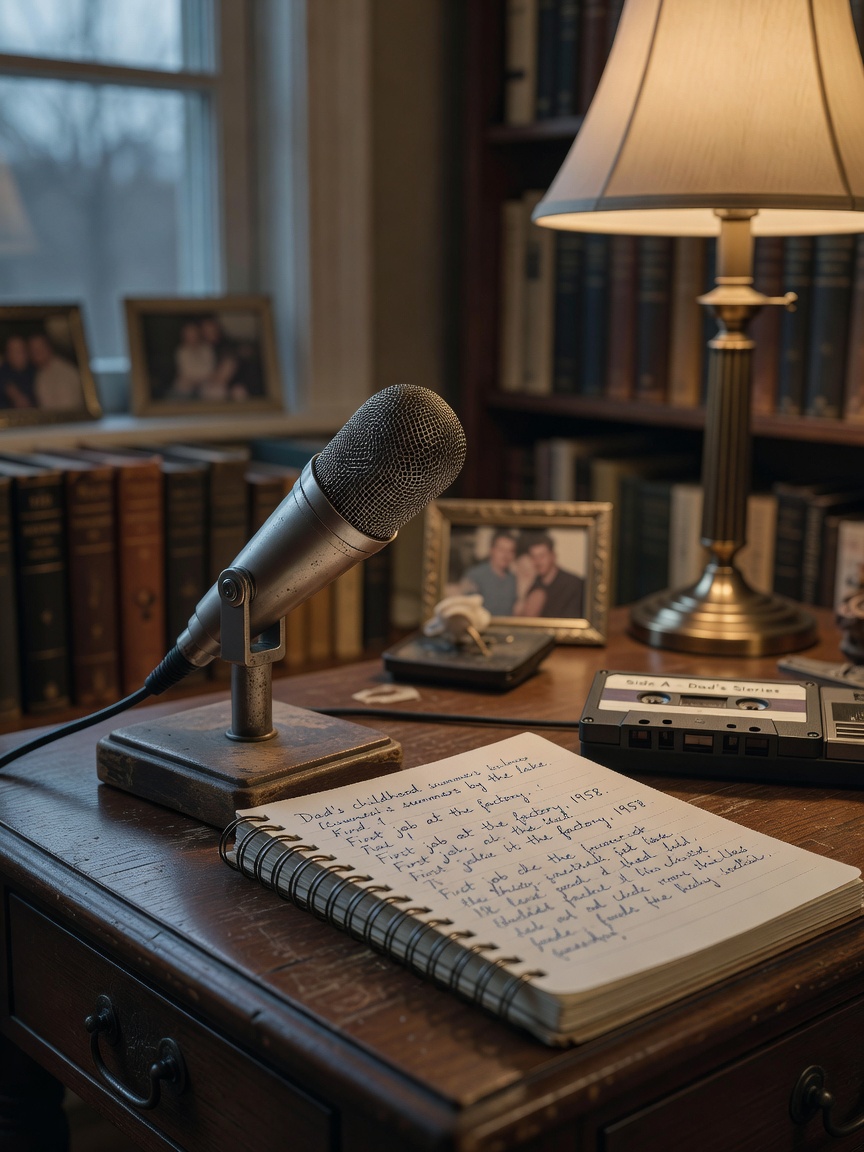
The Foundation: From Interview to Legacy
Recording a life story is the process of capturing a person's memories, experiences, and wisdom through audio or video for preservation. This practice creates a valuable historical and emotional archive for family members, ensuring that personal narratives and voices are not lost to time, providing connection for future generations.
I remember sitting with my own father, phone in hand, feeling a knot of anxiety in my stomach. I’d ask a question about his childhood and get a one-word answer. A shrug. A deflection. It wasn’t that he didn’t want to connect; the formal setting of an “interview” felt unnatural, like a performance. That silence is a familiar panic for so many of us. You realize that the library of his life—the stories of his first job, the sound of his mother’s voice, the mistakes that made him who he is—has no card catalog. And when he's gone, the library burns. We have to find a different way in.
Reframe the Mission: It's Not an Interview, It's a Legacy Project
The first step is to completely abandon the word 'interview.' For many men of a certain generation, an interview implies a test or an interrogation. Instead, frame it as a legacy project. This isn't about you getting something from him; it's about him creating something for his grandchildren. Say, "Dad, I want to make sure your grandkids know the story of how you built this family. Your voice, your experiences—that’s their inheritance. Can we work on that together?" This shifts the focus from emotional reminiscing to a tangible, purposeful act of providing for his family, a role he understands and values.
Kinnect is now LIVE! Start your private family group today.
👉 Try Kinnect on the Web
👉 Download the iOS App
The Power of the Side-by-Side Conversation
The most profound stories don't come from a face-to-face Q&A. They emerge when you're shoulder-to-shoulder, focused on a shared task. The pressure vanishes. This is the core of the 'sideways' interview technique. Place your phone, set to record, in a cup holder while you’re driving to the hardware store. Turn it on while you're both in the garage fixing a lawnmower, or while you’re fishing. The conversation will feel natural, and the stories will emerge from the context of the activity. His hands are busy, so his mind is free to wander back in time without the self-consciousness of a direct interview.
Practical Steps and Story-Starters for the Quiet Dad
Choosing Your Tools (Keep It Simple)
Don't get bogged down by technology. The best tool is the one you have with you. Your smartphone's built-in voice memo app is more than enough. The goal is clarity, not studio-quality production. Do a quick test to make sure it can pick up his voice from a few feet away, then put it aside and focus on the moment, not the equipment. The technology should be invisible.
Story-Starters, Not Questions
A question like "What was it like growing up?" is too big and can be overwhelming. A story-starter, on the other hand, gives him a specific door to walk through. Instead of asking fact-based questions, use prompts that invite a narrative.
- "Tell me about the worst trouble you ever got into as a kid."
- "Describe the first car you ever bought. What did it smell like?"
- "Walk me through the day you met Mom, from the moment you woke up."
- "What's a piece of advice your father gave you that turned out to be completely wrong?"
The Hidden Variable: The Power of the Prop
Conventional wisdom says you just need the right list of questions. But for a reserved father, the key isn't a question—it's an object. A sensory prompt can unlock a part of his brain that a direct query can't. Before you try to talk, bring a prop. Pull out an old, faded photograph of his parents. Hand him a tool he inherited from his own father. Play a song from the year he graduated high school. These objects act as a key, unlocking memories he may not have thought about in decades and giving him a concrete starting point for a story.
Where Does This Legacy Live?
Once you have these precious audio files, the final, critical question is: where do you keep them safe? A folder on your computer is fragile. A social media platform like Facebook isn't private and its business model relies on using your family's data. A group text on WhatsApp will bury these treasures under an avalanche of logistical noise and memes. Our research shows the vast majority of family communication—up to 70%—is just noise that buries meaningful connection.
This is why we built Kinnect. It’s a private, permanent home for your family’s most important stories. It’s a space designed for connection, not distraction. Here, your dad’s voice won’t be an algorithm’s data point or a file lost in a chaotic thread. It will be a cornerstone of your family’s digital home, a treasure his great-grandchildren can listen to one day, safely and privately. This addresses the Legacy Preservation Gap: while 85% of adults wish they had recorded their parents' voices, very few have a dedicated system to do so. Kinnect is that system.
FAQ: Recording Your Dad's Story
How do I get my dad to tell his story?
Reframe the task from an "interview" to a "legacy project" for his grandkids. Use a "side-by-side" technique, recording while doing an activity together like driving or working on a project. This removes the pressure of a formal, face-to-face conversation.
How do you record a parent's life story?
Use the voice memo app on your smartphone for simplicity. Focus on creating a relaxed environment and use story-starting prompts rather than direct questions. The technical quality is less important than capturing the authenticity of their voice and memories.
What questions should I ask my dad about his life?
Avoid broad questions. Instead, use specific story-starters like, "Tell me about the first time you drove a car," or "Describe the moment you knew you wanted to marry Mom." These prompts invite a narrative and are easier to answer than vague questions about the past.
Why is it important to record family stories?
Recording family stories creates a bridge between generations and strengthens family bonds. In fact, research shows that in families with regular storytelling traditions, children show 37% higher scores on family cohesion measures. It ensures that the voices, wisdom, and experiences that shaped your family are preserved forever.
Learn more at Kinnect.
